
Pre-Connected vs. Field-Spliced: Which FTTH Deployment Strategy Saves More Time and Cost?
Date: 2026-03-12
Fiber-to-the-Home (FTTH) deployment is accelerating globally, but operators and contractors still face a critical decision at the planning stage: Should we use pre-connected (pre-terminated) products or rely on traditional field splicing?
This choice directly impacts installation speed, labor costs, network reliability, and long-term maintenance. At Carefiber, we manufacture both solutions — so we have no bias. This guide breaks down the real trade-offs to help you make the right call for your project.
What Is Field Splicing?
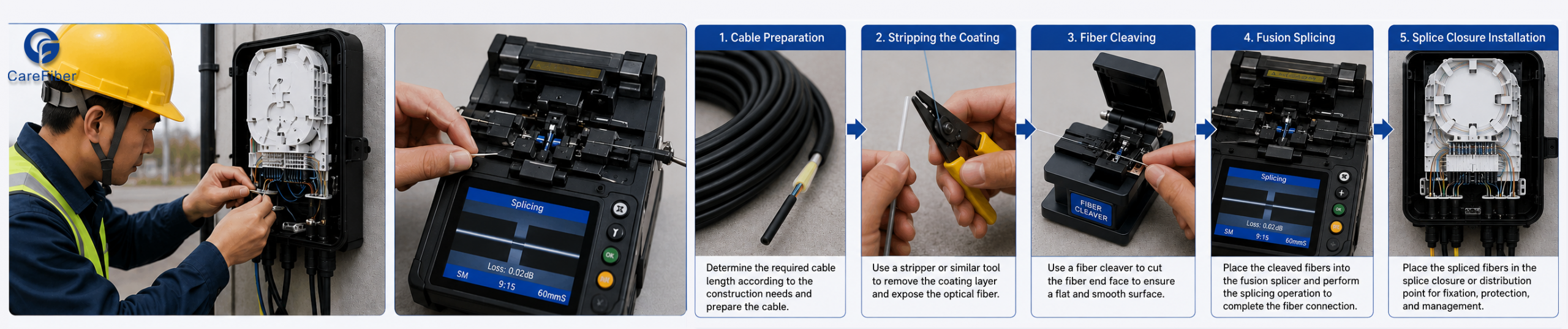
Field splicing involves cutting and joining fiber optic cables on-site using fusion splicers or mechanical connectors. Technicians prepare the cable, strip the buffer, cleave the fiber, and splice it inside a joint box or at the distribution point.
Common Field-Spliced Components
- Fusion splices in splice trays
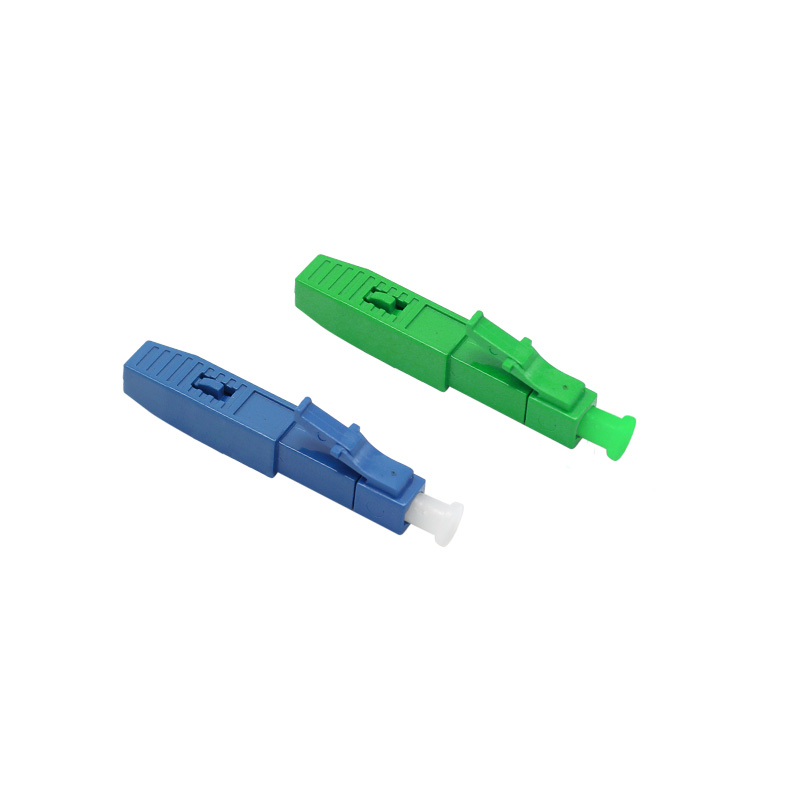
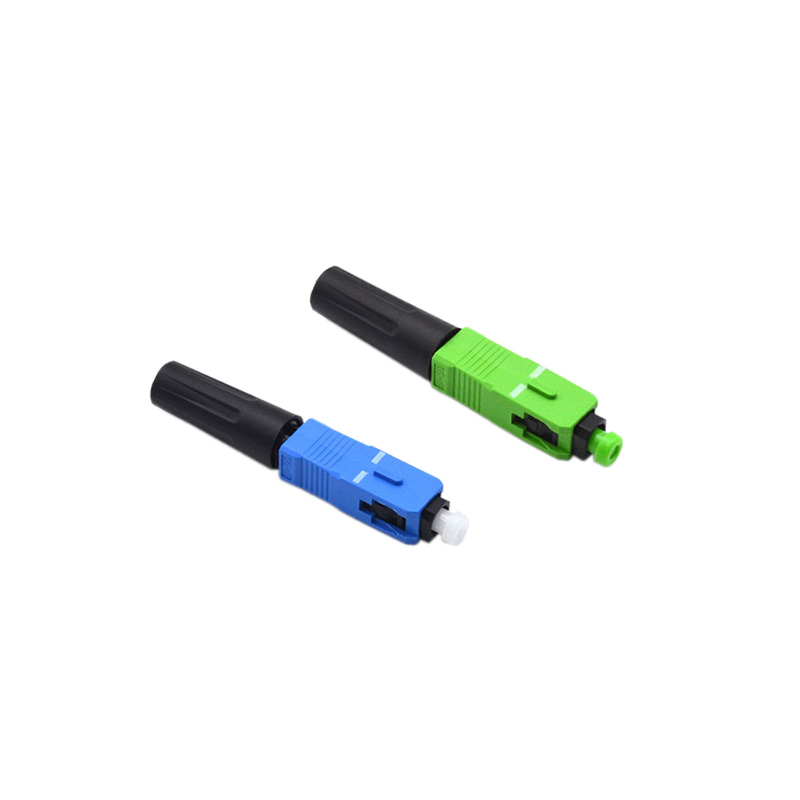
- Field-installable fast connectors (SC/LC/FC)
- Pigtails spliced to drop cables
- Splice closures and distribution boxes
When Field Splicing Makes Sense
- Custom cable lengths are required
- Complex topologies with non-standard routing
- Repair and maintenance scenarios
- Low-volume deployments where pre-connected inventory isn't justified
What Are Pre-Connected (Pre-Terminated) Solutions?
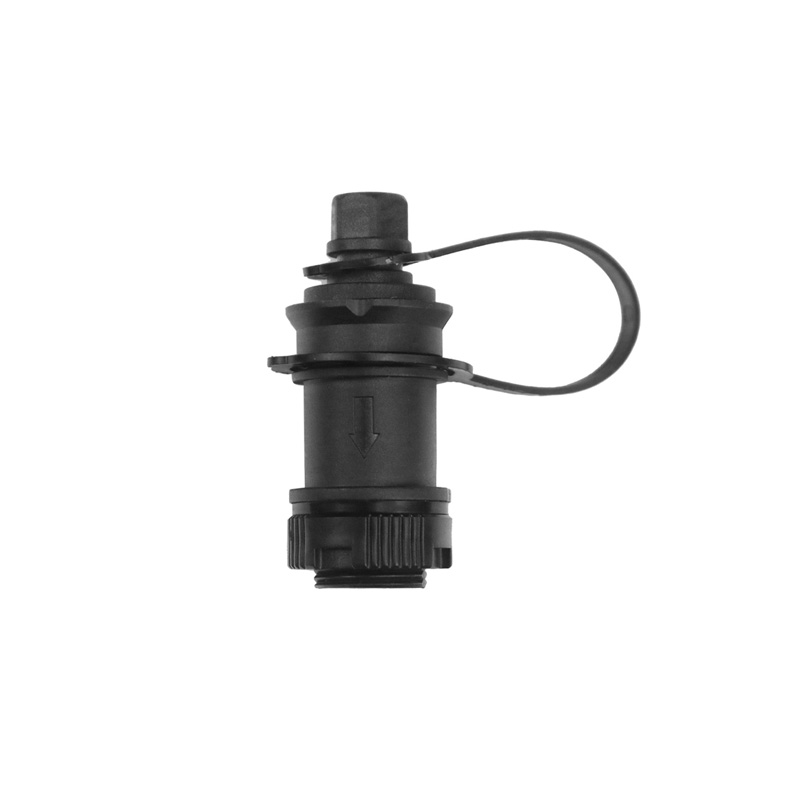
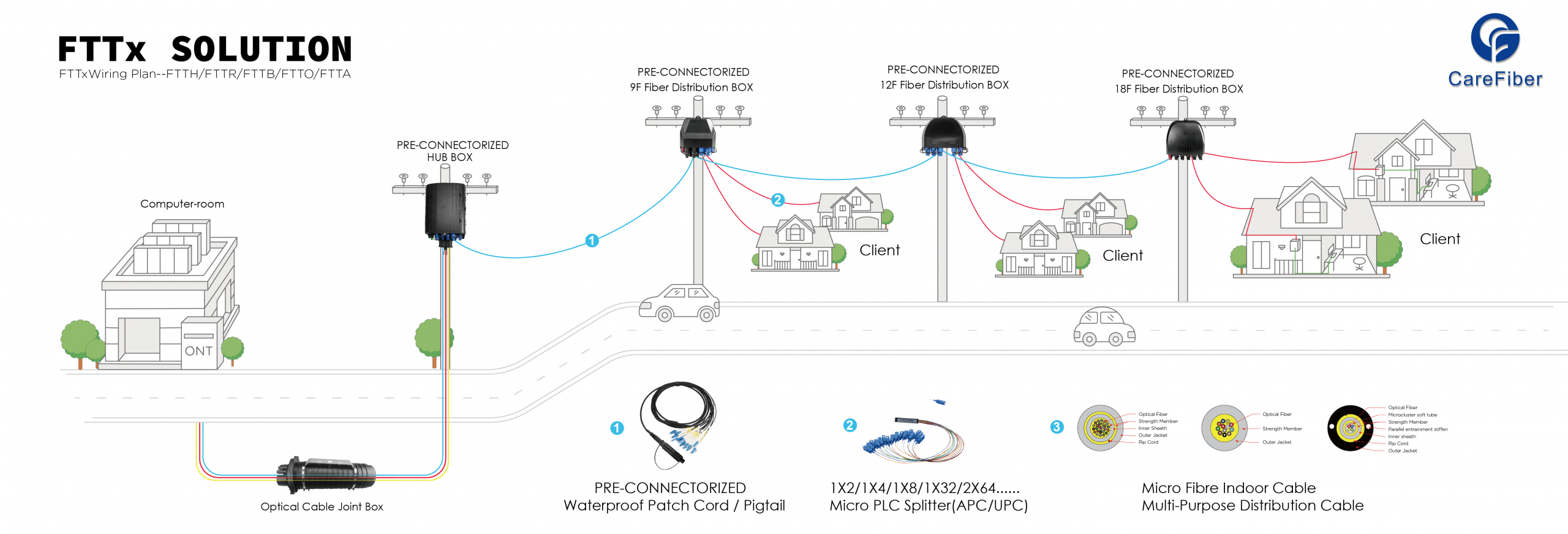
Pre-connected products arrive from the factory with connectors already attached, tested, and certified. They plug directly into splitters, ODFs, and customer premises equipment without any on-site fiber preparation.
Carefiber Pre-Connected Product Range
| Product | Application | Key Benefit |
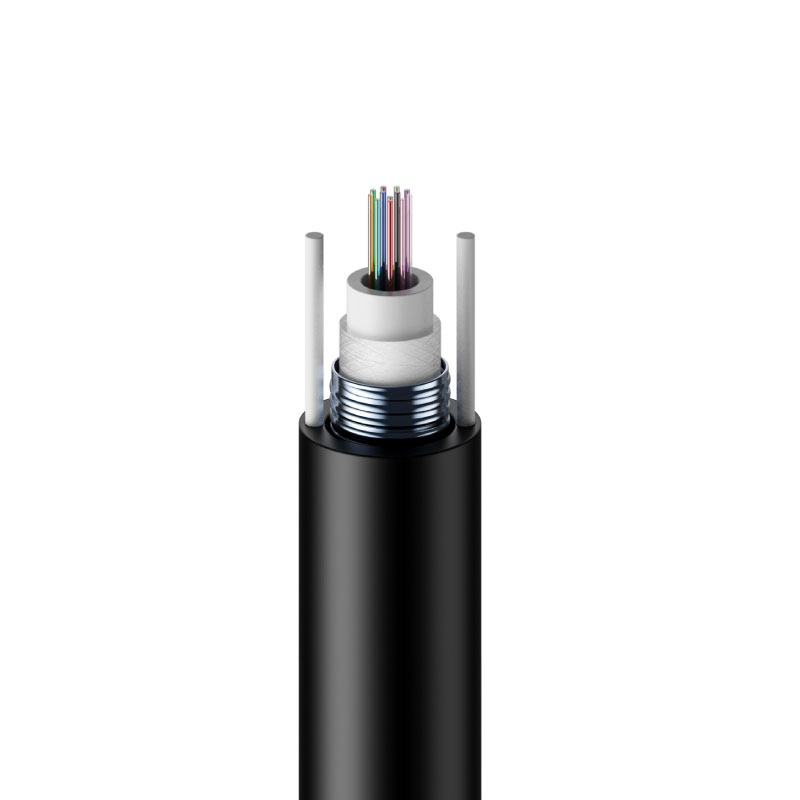
| Pre-connected drop cables | FTTH subscriber lines | Plug-and-play at ONT |
| Pre-terminated patch cords | Data center / ODF links | 100% tested, zero insertion loss risk |
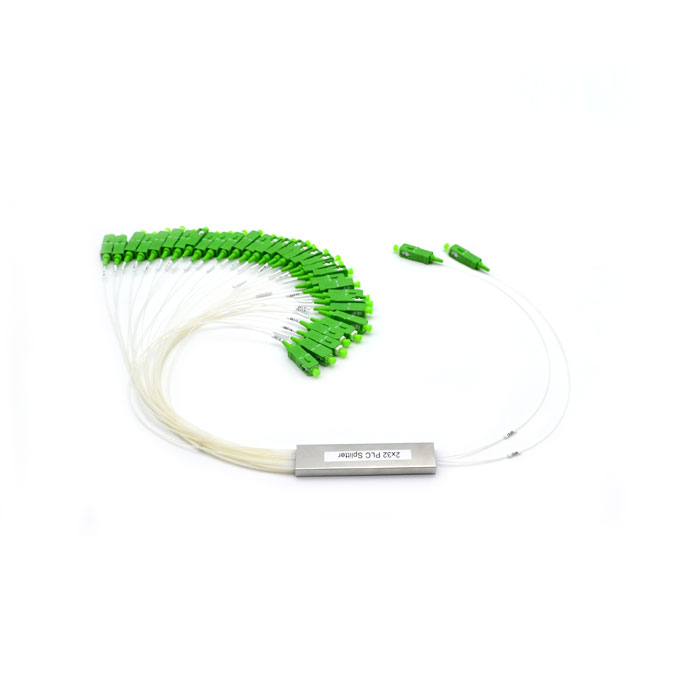
| Pre-connected PLC splitters | Distribution points | No field splicing at splitter ports |
| Fast connector assemblies | Quick repairs | Tool-less or minimal-tool installation |
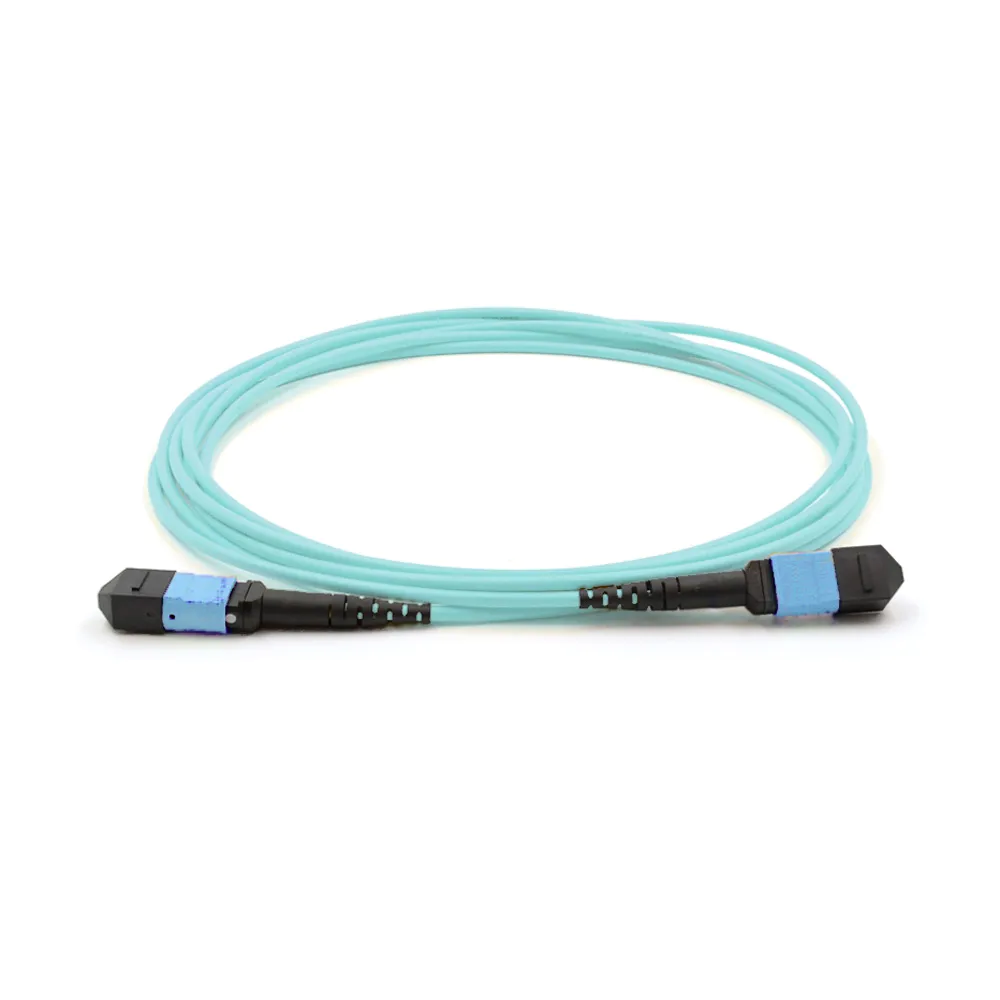
| MPO/MTP harnesses | High-density data centers | Multi-fiber push-on, 12/24 fibers at once |
Head-to-Head Comparison
| Factor | Field Splicing | Pre-Connected |
| Installation Time | 5–15 minutes per splice | 30 seconds to 2 minutes per connection |
| Labor Skill Required | Certified splicing technician | General technician/installer |
| Equipment Needed | Fusion splicer, cleaver, OTDR, power meter | None (or simple hand tools) |
| Initial Cost | Lower material cost | Higher material cost |
| Total Project Cost | Higher (labor + equipment + rework) | Lower (faster install, fewer errors) |
| Consistency | Varies with technician skill | Factory-controlled, 100% tested |
| Failure Rate | Higher (human-dependent) | <0.1% (certified pre-test) |
| Scalability | Limited by skilled labor pool | Easily scalable with standard crews |
| Rework Cost | High (re-splice, re-test) | Low (swap component) |
| Best For | Custom, low-volume, repair | Standard, high-volume, greenfield FTTH |
The Real Cost Breakdown
Let's look at a 1,000-home FTTH deployment:
Field-Spliced Approach
- 2,000 splices (2 per home average)
- 10 minutes per splice = 20,000 minutes ≈ 333 labor hours
- Technician rate: $50/hour = $16,650 labor
- Fusion splicer rental/depreciation: $2,000
- Rework (3% failure rate): 60 splices × $25 = $1,500
- Total: ~$20,150
Pre-Connected Approach
- 1,000 pre-connected drop cables + splitter ports
- 1 minute per connection = 1,000 minutes ≈ 17 labor hours
- General installer rate: $35/hour = $595 labor
- Material premium: $3,000
- Rework (0.1% failure rate): 1 swap = $50
- Total: ~$3,645
Note: Exact numbers vary by region and project scale. The pattern holds: pre-connected wins on total cost at scale.
When to Choose What?
Choose Field Splicing If:
- You're doing repairs or small custom jobs
- Cable routes are unpredictable and require exact on-site measurements
- You already own splicing equipment and trained staff
- The project is below 100 connections
Choose Pre-Connected if:
- You're deploying greenfield FTTH at scale (100+ homes)
- You need predictable installation timelines
- You want to reduce dependency on scarce, skilled technicians
- You're building a data center or high-density environment
- Quality consistency is a top priority.
Carefiber's Recommendation
For most modern FTTH rollouts, pre-connected is the default. The math is clear: faster installation, lower total cost, and better reliability.
However, the smartest operators combine both:
- Pre-connected for the bulk standard deployment (drop cables, splitters, patch cords)
- Field-splicable components for repairs, custom extensions, and non-standard drops. This hybrid approach gives you speed where it matters and flexibility where you need it.
Our Pre-Connected Product Lines
Carefiber manufactures a full range of pre-connected FTTH and data center products:
- Pre-connected FTTH drop cables — SC/APC, LC/UPC, or custom connectors
- PLC splitters — 1×2 to 1×64, with pre-connected input/output ports
- Patch cords — Single-mode and multimode, all standard connector types
- MPO/MTP assemblies — 8/12/24 fiber, for 40G/100G/400G data centers
- Fast connector kits — For quick field repairs without a splicer
Every pre-connected product is 100% factory-tested with IL/RL certificates included.
Conclusion
The "splicing vs. pre-connected" debate isn't about which is better in absolute terms — it's about which fits your project. For scale, speed, and cost control, pre-connected solutions dominate. For flexibility and custom work, field splicing still has its place.
Planning an FTTH Deployment?
Contact Carefiber for a free consultation. We'll analyze your topology, volume, and timeline to recommend the optimal mix of pre-connected and field-splicable components.